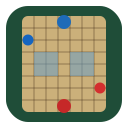
You only need three rules to begin: move one of your animals each turn, higher ranks usually capture lower ranks, and reaching the enemy den wins immediately. Red starts from the bottom of the board and moves first. The unusual parts—rats, rivers, traps, and lion or tiger jumps—are easier once you see where they happen.
Board and Terrain
The board has seven columns and nine rows. Red's den is in the middle of the bottom row; Blue's is in the middle of the top row. Three traps guard each den, and two rivers break up the center of the board.
Move any one of your animals into the opposing den to win. Your own den is not a legal square. An animal in an enemy trap temporarily has rank zero, so any defender may capture it. Its rank returns when it leaves the trap. Your own traps do not weaken your animals.
Capture Ranks
From lowest to highest, the ranks are rat 1, cat 2, dog 3, wolf 4, leopard 5, tiger 6, lion 7, and elephant 8. Equal ranks may capture each other, and a higher-ranked animal may capture a lower one. A dog, for example, can take a cat or rat but not a wolf.
The exception is the rat and elephant. On land, a rat can capture an elephant, but an elephant cannot capture a rat. A normal move goes one square up, down, left, or right—never diagonally. The destination must be empty or occupied by an enemy the moving animal is allowed to capture.
Rats, Water, and Land
Only rats may enter the rivers. Every other animal must stay on land, except that lions and tigers may jump directly to the opposite bank when the river path is clear.
The rat-elephant capture applies only when both pieces are on land. A rat in the water cannot capture a piece on the bank, and a land piece cannot capture a swimming rat. Two adjacent rats in the same river may capture under the normal rank rule.
Lion and Tiger Jumps
A lion or tiger standing beside a river may jump straight across it. Every water square in that line must be clear; one rat in the path is enough to stop the jump.
The animal lands on the first square beyond the opposite bank. That square may be empty or contain an enemy it can capture, but it cannot be your own den. The jump uses the whole turn.
Winning and Draws
You win the moment one of your animals enters the enemy den. You also win if your opponent begins a turn with no legal move. If sixty consecutive half-moves pass without a capture, this site declares the game a draw.
There is no score to count and no option to pass. In an online room, either player may resign or offer a draw. Against AI or on one device, you can resign or start over.
Complete a Move
Check whether Red or Blue is shown in the turn indicator, then select an animal of that color. The board marks every legal destination, including enemies it may capture. Choose one marked square to finish the move. If no square is marked, that animal cannot move from its current position; select another one instead.
Illegal Moves
You cannot move diagonally, move an ordinary animal more than one square, enter your own den, or send anything except a rat into the river. An elephant cannot capture a rat. A swimming rat cannot capture onto land, and a land animal cannot capture a rat in the water. Lions and tigers cannot jump over a rat, and no animal may capture an enemy above its permitted rank.
How the Modes Differ
The rules do not change between modes. AI games include hints, undo, and move-by-move replay. Same-device games include undo and replay without move suggestions. Online rooms keep both boards in sync and support resignations and draw offers, but one player cannot undo a move alone.
Only the opponent and available tools change. The legal moves stay the same. For help defending the den, controlling the rivers, and bringing pieces into an attack, read the Jungle Chess strategy guide.
FAQ
Can a rat really capture an elephant?
Yes, provided both pieces are on land. An elephant may not capture a rat, and a rat in the river may not capture an elephant on the bank.
Can lions and tigers always jump the river?
Not always. The lion or tiger must stand beside the river, and every water square in the jump path must be empty. Any rat in that path makes the jump illegal.
What happens in an opponent trap?
The trapped animal's rank falls to zero, so any opposing animal may capture it. Its normal rank returns when it leaves. Your own traps do not weaken your pieces.
Why can't I enter my own den?
Your den is the square your opponent is trying to reach, not a square your own animals may occupy. You must defend it from the surrounding squares.
Does Red always move first?
Yes. Every mode starts with Red. Against AI you may choose Red or Blue; if you choose Blue, the AI makes the opening move.
Can a game continue forever without captures?
No. This site declares a draw after sixty half-moves without a capture. Players in an online room may also agree to a draw before reaching that limit.